MOUNTAIN SAFETY
Welcome to Mt. Rose – Ski Tahoe! We’re excited to have you here and want to make sure you have a blast while staying safe on the slopes. That’s why we’ve teamed up with Ski California to bring you this Mountain Safety Guide.
Think of this guide as your friendly companion to skiing and snowboarding responsibly. It’s packed with tips to help you and your family enjoy a safe, fun-filled experience from start to finish. Safety is a big deal for us, and we focus on it every single day. By following the advice in this guide, using common sense, and making smart decisions, you’ll help ensure a great day for everyone.
So take a few minutes to check out the safety tips, and let’s make your visit to Mt. Rose an unforgettable and safe adventure!
Note: Snowsports carry inherent risks, which means certain risks are built into those sports’ basic nature, and ski resorts cannot eliminate them. Because of this fact, resorts are incredibly dependent on guests making good decisions constantly. Snowsports require active participation; whether it is loading and unloading chairlifts, paying attention to speed, skiing in control, or paying attention to safety messaging from resorts, guest decision-making is a significant driver of safety. Guests must understand their limits and respect their fellow skiers and riders. Therefore, resorts and guests must work together to ensure the safest environment possible while experiencing the thrill and excitement of the mountains.
Riding the
CHAIRLIFT SAFELY
Loading the Chair
- Get Ready
- Move to the Load Sign
- Sit Back Against the Chair
- Put the Bar Down
Unloading the Chair
- Raise the Bar
- Keep Ski Tips Up
- Stand Up and Push Off
- Clear Unload Area
BEFORE YOU SKI OR RIDE
Skiing and snowboarding are active and exciting outdoor sports with inherent risks that cannot be eliminated, including the risk of serious injury and death. Because of these risks, it is YOUR responsibility to be aware of your surroundings, the conditions, and your ability.
- Know Your Responsibility Code (see below)
- Wear a properly fitted helmet with the chin strap securely tightened to help prevent or minimize injuries.
- Use properly maintained equipment.
- Have bindings inspected and correctly adjusted by a certified technician.
- Dress in water– and wind-resistant outerwear and layers to accommodate changing conditions.
- Use sunscreen and wear goggles or sunglasses. The sun at altitude is intense, even on cloudy days.
- Skiing and snowboarding are active sports. Know your physical limits.
- Take a lesson. Every experience level can benefit from professional instruction
YOUR RESPONIBILITY CODE
Know and Obey the Code, It’s Your Responsibility. If you need help understanding the Code, please ask an employee.
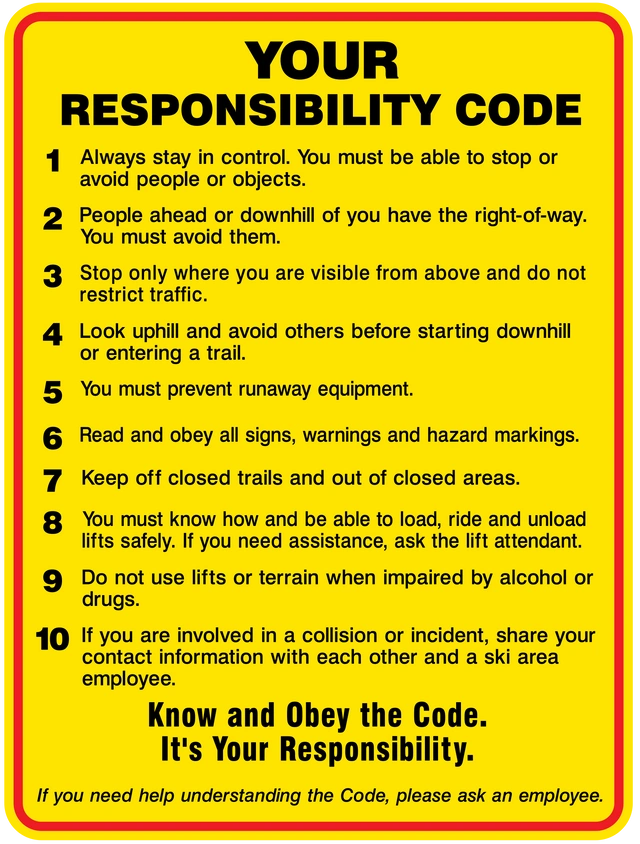
Please visit the Mountain Safety Guide for a complete understanding of Your Responsibility Code.
SAFETY Commitment
your safety is
our priority
- We provide guest education on how to ski and snowboard responsibly.
- We offer ski and snowboard lessons from qualified instructors.
- We staff a trained ski patrol to provide first aid, assess mountain safety, post warnings, close trails, and conduct avalanche mitigation (when necessary).
- We conduct ongoing lift inspections and maintenance, work with regulatory agencies, and staff train lift operations personnel to operate lifts.
- We monitor weather and mountain conditions and modify operations when appropriate.
- We provide trail difficulty rating symbols relative to a resort’s specific terrain.
- We use required and industry-approved signage to help direct and educate guests.
AVALANCHE
AWARENESS
- Many ski resorts have avalanche-prone terrain, and the risk of avalanches cannot be completely eliminated.
- Ski Patrols use a variety of techniques and equipment for avalanche mitigation, including explosives. Avalanche mitigation may require terrain closures and delayed opening. For your safety, never enter a closed area.
- Snow conditions constantly change as a result of wind, temperature, new snowfall, and skier/snowboarder use.
- Snow movement – from small sloughs to larger avalanches – can occur both in and out of bounds, particularly when skiing or riding in or near steeper terrain.
- If you leave the ski area boundary, which is illegal at some resorts, you do so at your own risk. Areas outside the boundary are neither controlled nor patrolled, and the ski patrol is under no obligation to conduct a rescue. Avalanche education, proper equipment, and a partner are essential if you choose to enter the backcountry. Contact your local avalanche center or visit the Ski California website for more information.
- For an introduction to avalanche safety, please watch this exceptional video featuring some of the best athletes in the world and visit kbyg.org
AIARE and Mt. Rose Avalanche Education – We are now offering a limited amount of Avalanche Rescue / Educational classes during the season. Please visit the Avalanche Education page for details.
ON THE SLOPES
Most skiing and snowboarding incidents result from skiers or riders traveling too fast or beyond their ability. The most common serious injuries result from colliding with objects or other people at a high speed. You can reduce the likelihood of injury on the slopes if you slow down and are able to stop to safely avoid objects and people at all times.
- Ski or Ride in Control. Be aware of your surroundings at all times. Ski or ride at a speed you are able to safely stop and avoid others and objects you may encounter.
- Look Out for Hazards and Obstacles (natural and man-made). Resorts may use poles, flags, discs, ropes, fencing, signs, and other devices to provide visual warnings. No resort can mark all hazards and obstacles. Be aware of changing conditions.
- Do NOT go under ropes or enter closed areas. Ropes and closures are in place for your safety. Do NOT Ski or Ride Impaired. It is unsafe and against the law. Be responsible for alcohol consumption.
- Stay Hydrated. Your body requires more fluids at higher elevations.
- Know Your Limits. If you’re tired, STOP. If you’re injured, contact Ski Patrol.
- NO Horseplay. Always be respectful of others.
- Look Out for Over-Snow Vehicles. They may be on the slopes heading uphill or downhill, so stay clear of them at all times.
- No Uphill Traffic. Mt. Rose does not permit uphill traffic at any time (no “skinning” or hiking uphill before opening / during operations / or post closing) See “Back Country Access” section below for guidelines on accessing terrain off the southeast border of the Slide Bowl.
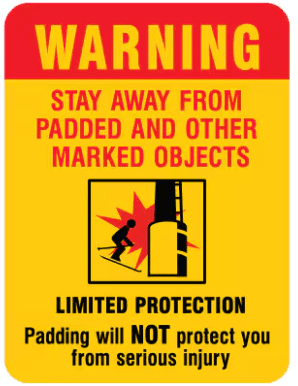
deep snow safety
- Avoid Tree Wells. These are voids or depressions in the snow that forms around the base of a tree and are often hidden by low branches. Skiers and riders can fall into these wells and die. To avoid tree wells, steer clear of trees and stay in control.
- Stay With a Buddy. Always maintain visual contact and stay close enough that you can pull or dig each other out of deep snow.
- Carry Information. Have ski patrol phone numbers so you can quickly call for help<(but be aware of areas without cell coverage).
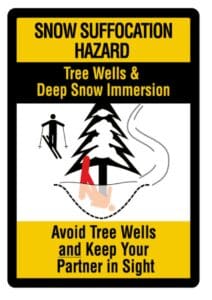
For more information, please visit http://www.deepsnowsafety.org/
Trail Signage
Trail maps contain a wealth of information, including trail and lift locations, trail difficulty rating symbols, where to find information, ski patrol, and other mountain services. Trail difficulty ratings are relative to each resort’s specific terrain. A blue square trail at one resort may be easier or more difficult than a blue square trail at another resort. Work your way up from easier to more difficult trails. When in doubt about a trail or what type of terrain a particular lift serves, ask resort staff for guidance.
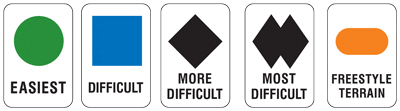
Trail rating symbols indicate the difficulty level of the terrain. Here’s what they mean:
- Green Circle: Easier
- Blue Square: Difficult
- Black Diamond: More Difficult
- Double-Black Diamond: Most Difficult
- Orange Oval: Freestyle Terrain
Lift Safety
LIFT LOADING
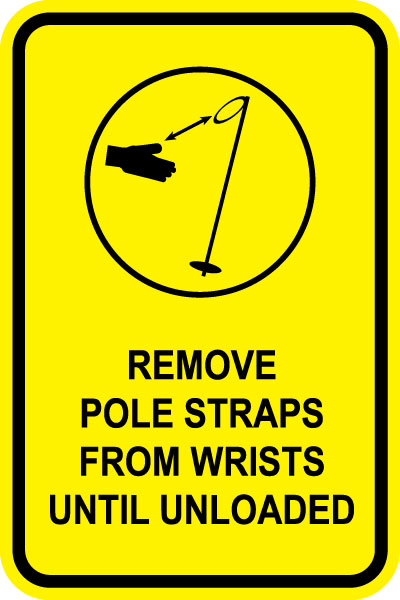
- Remove pole straps from wrists and hold them in one hand. Remove backpacks and hold them in your lap.
- Remove the back foot from the snowboard binding.
- Be lined up with other guests and prepared to load before moving forward from the “Wait Here” area.
- After the chair in front passes, move from the “Wait Here” area to the “Load Here” area.
- At the “Load Here” area, look back and grab the part of the chair that is easiest for you, typically a sidebar or backrest.
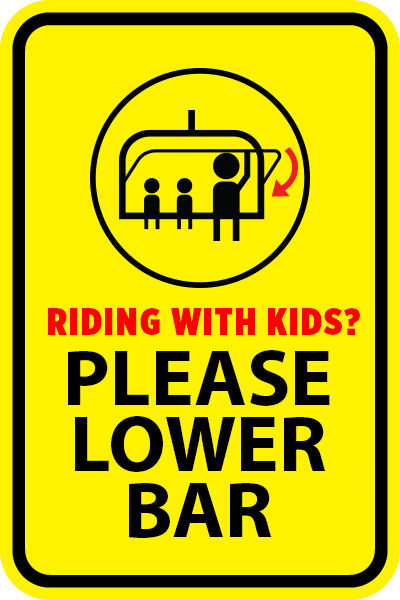
- It is recommended that children under 48″ tall ride the lift with an adult.
RIDING LIFT
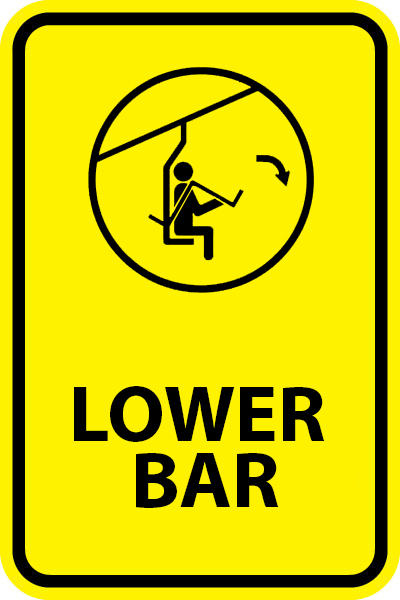
- When a restraint bar is available, tell others and lower the bar when you can do so safely.
- SIT BACK and remain seated.
- NO HORSEPLAY.
- Do not turn around or otherwise move on the chair, even if the lift slows or stops. Never jump from the chair.
LIFT UNLOADING
- Check for loose clothing or equipment (such as backpacks) to ensure it will not get caught.
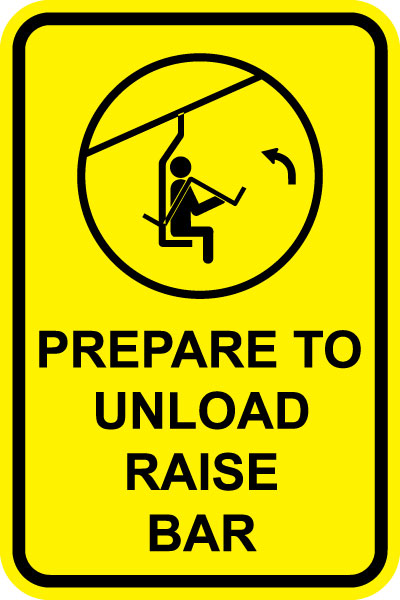
- If a restraint bar is lowered, tell others and then raise the bar before the “Unload Here” area.
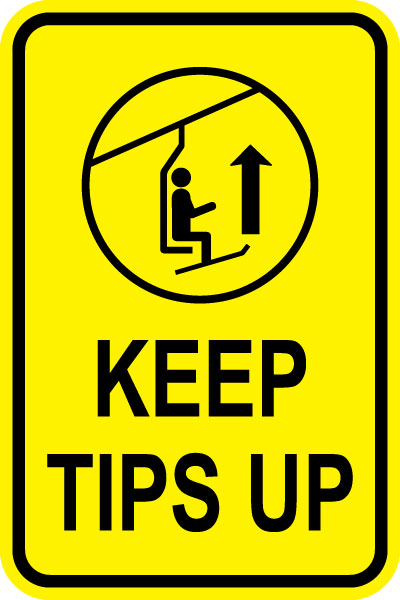
- Keep your ski tips or the front of your board up and straight ahead.
- After unloading, move away from the unloading ramp.
- If you fail to unload at the “Unload Here” area, remain completely seated and wait for further assistance. DO NOT JUMP.
If you need assistance or there is a problem, SPEAK UP and tell a lift operator.
For further information about lift safety, please visit:
Kids on Lifts – Kidsonlifts.org
backcountry access
Two exit areas off the South Rim of the Winters Creek Lodge Side will take you into the backcountry.
If you are heading out from the Winters Creek Lodge, you are asked to hike just outside the rope line on the Log Flume trail to avoid downhill traffic
Please remember:
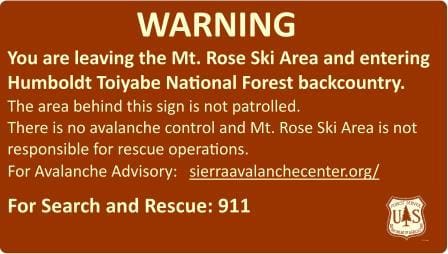
- The area behind the exit signs is not patrolled.
- There is no avalanche control, and Mt. Rose Ski Area is not responsible for rescue operations.
For Avalanche Advisory: sierraavalanchecenter.org/
For Search and Rescue: 911
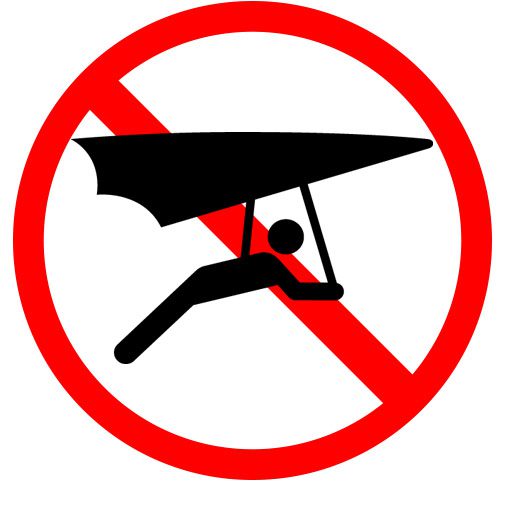
Paragliding & Hang-gliding
Aerial Devices & Launching Policy
To protect guest safety and mountain operations, the following activities are prohibited on all Mt. Rose Ski Tahoe property (including parking lots and access roads):
- Paragliding
- Hang-gliding
- Speed flying
- Parachute-assisted or device-assisted uphill travel
- Any launching or landing of gliders, chutes, or similar devices
Unauthorized aerial activity is not allowed at any time.911